
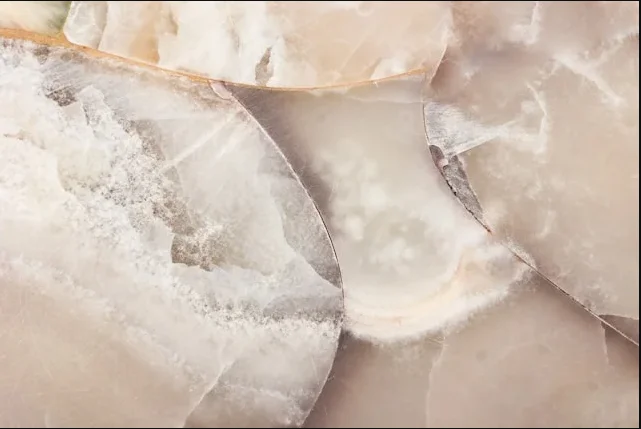
Marble does not lose its shine because a coating wore off. Polished marble has no coating. The shine comes from the surface of the stone itself being ground so smooth that it reflects light like a mirror. When marble goes dull, it is because that smooth surface has been damaged by acid (etching), by grit (scratching), or by film left behind from soap and the wrong cleaners.
That means no spray, wax, or polish in a bottle can bring it back. The only real fix is to remove a very thin layer of the stone with diamond abrasives and make it smooth again. That is what marble honing and polishing is.
What Marble Shine Really Is (And Why It Disappears)
Marble is made mostly of calcium carbonate the same mineral as limestone and chalk. It is a fairly soft stone.
When marble is polished, machines pass over the surface with finer and finer diamond abrasives. Each pass removes the scratch pattern left by the pass before it. At the end, the scratches are so small that your eye cannot see them. Light hits the surface and bounces straight back. You see a reflection. That is shine.
Now flip it around. Anything that makes that surface rough again even by a few microns makes the light scatter instead of reflect. You see a dull patch, a cloudy area, or a foggy walkway.
So the honest way to say it is this:
Marble does not “lose” shine. The surface loses smoothness.
Once you understand that one sentence, everything else in this article makes sense.
The 6 Real Reasons Marble Goes Dull
1. Etching — the number one cause
This is the big one, and most homeowners have never heard the word.
Etching happens when something acidic touches marble. The acid reacts with the calcium carbonate and dissolves a microscopic layer of the stone. What is left behind is a rough, dull, whitish mark where the polish used to be.
Common things in an Atlanta home that etch marble:
Lemon juice, lime, orange juice
Vinegar (including “natural” vinegar cleaners)
Wine and coffee
Tomato sauce and salad dressing
Soda
Toothpaste, mouthwash, perfume, face wash, hair products
Bathroom cleaners, tile cleaners, lime scale removers, bleach, glass cleaner
The reaction is fast. A drop of lemon juice can start marking the surface in well under a minute. A wine glass left overnight leaves a ring you can see from across the room.
Two things people get wrong about etching:
An etch is not a stain. A stain is colour that soaked into the pores. An etch is physical damage to the surface. Cleaning an etch harder will never remove it.
Sealing does not stop etching. A sealer reduces how much liquid soaks in, which helps with stains. But the acid does not need to soak in to cause an etch it reacts with the surface itself. This is the single most common misunderstanding we hear on service calls.
2. Scratching and traffic wear
Marble is soft. Sand, grit, and small stones on the bottom of shoes act like sandpaper on the floor.
You will usually notice this first in a “traffic lane” the path from the front door to the kitchen, or the strip in front of the bathroom vanity. The rest of the floor still shines. That one lane looks grey and flat. That is thousands of tiny scratches, not dirt.
3. Soap scum and cleaning film
In showers, body wash and shampoo leave a thin film on the marble. It builds up slowly. The stone starts to look cloudy and feels slightly slippery even when it is clean.
The same thing happens on floors when someone mops with a soapy cleaner and never rinses. Layer by layer, a dull haze forms over the shine.
4. Mineral deposits and efflorescence
Water sitting on marble evaporates and leaves its minerals behind. In showers this shows up as hard water spotting on the walls and floor.
There is also a second, deeper version of this problem called efflorescence. Moisture moves up through the slab or the setting bed underneath the tile. It carries dissolved salts with it. When the water evaporates at the surface, the salts are left behind as a white, chalky powder. Wipe it off, and a week later it is back.
Efflorescence is a moisture problem, not a cleaning problem. Polishing the floor without fixing the moisture source just resets the clock.
If the salts crystallise just below the surface instead of on top of it, they push outward and break small flakes off the stone. That is called spalling, and it shows up as pitting or flaking. This is common where de-icing salt gets tracked in, and on exterior stone.
5. Wax, acrylic, and “shine restorer” products
Many big-box products marketed for stone floors are topical coatings. They put a plastic or wax layer on top of the marble.
They do look good for a few weeks. Then they wear unevenly in traffic areas, yellow with age, scuff, and trap dirt. And because they seal the surface from above, they can trap moisture inside the stone and make efflorescence and spalling worse.
Then someone has to strip all of it off before the stone can be properly restored. We do this often, and it is more work than the original polish would have been.
6. An old restoration that has simply run out
Even a perfect professional polish is not permanent. It is the top surface of a soft stone in a house where people walk, cook, and shower. In a busy Atlanta home, a floor polish holds up well for a few years, a countertop for a couple of years, and a shower depends entirely on how it is cleaned.
That is normal. Marble is a maintained surface, like hardwood. It is not a “fit and forget” material.
The Atlanta Factor: What Our Climate Actually Does
You asked a fair question: does Atlanta weather really matter for marble? We checked the climate data rather than guessing, and here is the honest version.
Atlanta has a humid subtropical climate. Under the Köppen system it is classified as Cfa, with no dry season — mild, rainy winters and hot, muggy summers. Average relative humidity across the year sits around 68%, peaking near 75% in August and only dropping to about 61% in April. The city gets roughly 50 inches of rain a year, spread through every month. July highs average around 89–90°F, and January lows average around the freezing mark.
Here is how each of those numbers touches your stone.
Humidity: the slow, quiet one
High humidity does not scratch marble. It works indirectly, in three ways:
- Spills and residues stay wet longer. A drop of lemon juice on a Phoenix countertop dries fast. In an Atlanta August, the air is already near 75% humidity, so that drop stays liquid — and stays reacting with the stone — for longer. Longer contact means a deeper etch.
- Showers never fully dry out. A marble shower in a humid climate stays damp between uses. That is ideal for soap scum build-up, mould in the grout, and mineral haze on the walls. It is one reason marble showers in metro Atlanta dull faster than marble showers in dry states.
- Moisture moves through the slab. With 50 inches of rain a year, ground moisture under a slab-on-grade floor is a real thing here. That moisture migrates upward through the setting bed and the stone, carrying salts. That is the efflorescence problem described above. Basements, ground floors, sunrooms, and entryways are the usual suspects.
Practical takeaway: if you have a marble shower or a ground-floor marble entry in Atlanta, run the exhaust fan longer than you think you need to, and squeegee the shower. It genuinely extends the life of the finish.
Pollen: the Atlanta-specific one
Atlanta is called the city in the forest for a reason, and the pollen record shows it. Metro Atlanta’s tree, grass, and weed seasons overlap into a roughly nine-month cycle, and spring counts regularly reach “extremely high” in 2025, Atlanta recorded ten straight days at extremely high levels, with one daily count above 7,000 grains per cubic metre. Counts have been running earlier and longer in recent years.
For marble, pollen matters for two reasons:
- It is fine solid material tracked in on shoes, paws, and clothing. It combines with dust and grit and gets ground into the floor underfoot. On a soft stone, that is abrasion.
- It is why people over-clean in spring. March through May, homeowners mop far more often — and often reach for a stronger cleaner to cut the yellow film. That is when we see acid damage from all-purpose sprays and bathroom cleaners on marble floors and vanities.Pollen season is the single busiest period for dulled Atlanta marble floors in our experience. It is not the pollen itself so much as the grit it comes with and the cleaning habits it triggers.
Red clay and rain
North Georgia’s red clay is a fact of life here. Fifty inches of annual rain means muddy shoes several times a month, and clay carries sand and grit with it. Every wet footprint on an unprotected marble entryway is a small abrasive event.
Red clay also stains. Iron-rich clay ground into porous stone or grout is one of the harder discolouration problems to reverse, and it is a strong argument for keeping marble entries sealed and using proper walk-off matting.
Temperature swings and freeze-thaw
Summer highs near 90°F and January lows near freezing create real thermal movement in exterior stone patios, pool decks, steps, thresholds, fountains, and cemetery or monument marble.
When water sits in the pores of exterior marble and then freezes, it expands and breaks off thin layers. That is freeze-thaw damage. Atlanta does not get Chicago winters, but it gets enough freeze nights each year to matter over a decade. Exterior marble needs a breathable penetrating sealer and good drainage, not a film-forming coating.
Water hardness: less of a problem here than elsewhere
We want to be accurate rather than dramatic on this one. Metro Atlanta draws most of its water from the Chattahoochee River system and Lake Lanier, which is surface water and generally on the softer side compared with the groundwater-fed Southwest. Reported figures vary quite a lot by source and by county the City of Atlanta and Fulton County are usually described as soft to moderately hard, while some outer suburbs such as North Fulton test higher.
So yes, hard water spotting happens in Atlanta showers. But it is a smaller factor here than in Phoenix or Las Vegas. If your shower marble is dull, soap film and etching from cleaners are more likely to be the cause than scale.
What Does Not Bring the Shine Back
We are including this section because these are the exact things people try before they call us, and several of them make the job bigger.
- Vinegar, lemon juice, or baking soda paste. Vinegar and lemon are acids — they cause the exact damage you are trying to fix. This advice is everywhere online and it is wrong for marble.
- Bleach, glass cleaner, all-purpose spray, tub and tile cleaner. Most are not pH neutral. Anything that advertises “removes hard water deposits” is designed to dissolve calcium, which is what your countertop is made of.
- Wax and acrylic floor finish. Temporary shine, long-term problem, and someone has to strip it later.
- Sealing the marble. A penetrating sealer is a good idea, but it is not a shine product. It is invisible. It reduces staining. It does nothing for etching or scratches. If a company tells you sealing will restore your shine, ask more questions.
- Steam cleaners. Forcing hot moisture into a stone that already has a moisture problem is the wrong direction.
- Melamine sponges (magic erasers). They are a fine abrasive. On polished marble they leave a dull patch.
- A random buffing pad from a hardware store. Buffing a scratched surface just makes a shinier version of a scratched surface. The scratches have to be removed first.
What Actually Brings It Back: The Professional Process
Real marble restoration is a mechanical process, not a chemical one. To restore the shine, a professional removes a microscopic layer of the stone and refines it until it reflects light again. Here is the sequence we follow, and why each step exists.
Step 1 — Inspect and diagnose
Before any machine touches the floor, the surface needs to be read. What is the damage etch, scratch, film, coating, moisture? How deep does it go? Is there lippage (tiles sitting at different heights)? Is there an old coating that has to come off? Is the grout failing? Is moisture coming from below?
This step decides the starting grit, and starting at the wrong grit is the most common way an amateur job goes wrong. Too coarse removes more stone than necessary. Too fine will not touch the damage.
Step 2 — Deep clean and strip
The stone is cleaned with pH-neutral products, and any wax, acrylic, or old topical coating is stripped off. Abrasives cannot work correctly through a layer of old finish.
Step 3 — Grinding (only when it is needed)
Grinding uses coarse diamond abrasives roughly 50 grit and below to remove a meaningful layer of stone. It is used for deep damage, heavy wear, or to flatten lippage so the floor reads as one continuous surface instead of individual tiles.
Most homes do not need grinding. It is the most aggressive option, it removes the most stone, and a good restorer will avoid it unless the condition calls for it.
Step 4 — Honing
Honing is the heart of the job. The surface is worked through a sequence of progressively finer diamond abrasives — commonly starting somewhere between 100 and 400 grit depending on the damage, then moving up. Each grit removes the scratch pattern left by the previous grit and replaces it with a finer one.
This is the step that physically removes etch marks and scratches. There is no shortcut around it. You cannot skip grits either — jumping from coarse to fine leaves the coarse scratch pattern visible under the gloss.
If you want a matte or satin look instead of a mirror, this is where the process stops. That is a honed finish, and it is worth considering: a honed surface hides etching far better than a polished one, because there is less contrast between the damaged spot and the surrounding stone. For a busy family kitchen in Atlanta, honed is often the more practical choice.
Step 5 — Polishing
Polishing continues the same idea with very fine abrasives — 800 grit and up, often through 3000 grit and beyond — usually finished with a polishing compound or powder. Many of these powders contain a mild agent such as potassium oxalate that helps develop depth and clarity in the stone.
The result is a reflection produced by the marble itself. No coating, no film. This is the difference between restored marble and “shined up” marble, and you can see it in person: a real polish has depth, a coating has a plasticky flatness.
Pressure, speed, and water control all matter here. Too much pressure builds heat and creates uneven gloss. This is why hand-buffing rarely matches machine polishing.
Step 6 — Sealing
Finally, a breathable penetrating sealer (an impregnator) is applied. It soaks into the pores and reduces liquid absorption, which buys you time to wipe up a spill before it stains.
Two honest notes:
A sealer does not prevent etching. Nothing does, except keeping acids off the stone.
On floors with moisture coming up from below, the sealer must be breathable. Film-forming products trap that moisture and cause the flaking problems described earlier.
A word on crystallisation
You may be offered a process called crystallisation. It uses an acidic fluorosilicate compound worked into the surface with steel wool under a floor machine, forming a hard, glassy skin.
It is faster and cheaper than a full diamond polish, and it can produce a high gloss on dense marble. It is also genuinely debated in the trade. The concerns are that the skin can wear through unevenly, can yellow over time, and can reduce the stone’s ability to breathe which is a bigger deal in a humid climate with slab-level moisture, like ours.
Our position: it has a place on some commercial installations, but for a residential Atlanta floor with any moisture history, a straight diamond polish is the safer, longer-lasting choice. Whatever you decide, you should know which one you are being sold.
What You Can Do Yourself vs When to Call a Pro
Reasonable to try yourself:
- Daily cleaning with a pH-neutral stone cleaner, or plain warm water
- Blotting spills immediately instead of wiping them across the surface
- Removing light soap film with a stone-safe cleaner and a soft pad
- One small, shallow etch mark on a countertop with a proper marble polishing powder, following the instructions carefully and testing in a hidden spot first
Call a professional when:
- The dullness covers a whole floor, a whole countertop, or a walkway
- You can feel depth in a scratch or etch with your fingernail
- There is a white powder that keeps coming back
- Tiles sit at different heights, or the grout is failing alongside the stone
- There is an old wax or acrylic coating to remove
- The marble is a shower, a fireplace surround, a staircase, or anything vertical
- It is a high-value or historic piece
The reason is not gatekeeping. It is that DIY on marble almost always creates a patch a small area of different gloss that stands out more than the original problem did. Blending a repair into the surrounding stone so it disappears is the skilled part of the job.
How to Keep the Shine Longer in Atlanta
A realistic, Atlanta-specific maintenance routine:
Every day
- Wipe spills straight away, especially anything acidic
- Use coasters, trivets, and a cutting board on marble counters
- Squeegee the shower walls and floor, and leave the exhaust fan running for 20–30 minutes after
Every week
- Dust mop floors before you wet mop. Dry grit is what scratches
- Clean with a pH-neutral stone cleaner only. Rinse and dry
- Check the label: if it does not say safe for natural stone, do not use it on marble
Seasonally
- Late winter through spring (pollen): increase dust mopping, use quality walk-off mats at every exterior door, and enforce a shoes-off rule. This is the highest-wear window of the Atlanta year for stone floors
- Summer (heat and humidity): watch showers and ground-floor rooms for haze and white residue. Run dehumidification if you have it
- Fall: best window for professional restoration, before holiday traffic
- Winter: keep de-icing salt away from marble steps, thresholds, and entryways. Salt is one of the worst things for stone
Every 12–24 months
- Reseal with a penetrating impregnator, or ask for a water test to check whether it is due
Every few years
Professional hone and polish. Rough guidance for Atlanta homes:
- Busy floors and entryways: every 2–4 years
- Kitchen countertops: every 1–3 years, depending on how they are used
- Showers: every 1–2 years, mostly driven by humidity and soap film
- Low-traffic areas, guest baths, formal rooms: 5+ years
These are ranges, not rules. The right interval depends on your household, not on a calendar.
Frequently Asked Questions
Can dull marble always be restored?
Almost always. Because the shine is the stone itself, and the process removes a thin layer to reveal fresh stone underneath, marble can be restored many times over its life. The exceptions are severe structural damage, deep spalling, or very thin material that has already been ground repeatedly.
How much marble is removed during polishing?
Very little. A standard hone and polish removes a fraction of a millimetre. A marble floor can be restored many times across decades without any practical loss of thickness.
Will it stay shiny forever this time?
No. It is a maintained finish. What changes is how long it lasts, and that depends almost entirely on which cleaners you use and how much grit reaches the surface.
Is a honed finish better than polished for Atlanta homes?
Often, yes especially for kitchens and busy family floors. Honed marble hides etching and light scratching far better. Polished looks more dramatic and is easier to keep clean, but it shows every mark. It is a lifestyle decision more than a quality decision.
My marble is dull only in one path across the room. Why?
That is traffic wear thousands of tiny scratches in the walking lane. It is one of the most satisfying things to restore, because the difference is immediate and obvious.
Does sealing prevent etching?
No. This is the most common misunderstanding in stone care. Sealing reduces staining. Only avoiding acids prevents etching.
Can I use a steam mop on marble?
We do not recommend it, particularly on ground-floor installations in a humid climate.
Talk to Georgia Marble Services
We restore marble floors, countertops, showers, vanities, fireplaces, and entryways across Atlanta. Every job starts with an in-person inspection, because the right process depends entirely on what is actually wrong with your stone — and sometimes the answer is a deep clean rather than a full restoration.
Request a free marble assessment in Atlanta


